Fence material planning
Back to calculator ↑Measure the fence line, not the plot
Measure along the line the fence will actually follow, in metres. Don't use the plot area. A 200 m² plot can have very different perimeters depending on its shape. Treat each straight side as its own measurement, and calculate fences with different heights or designs separately.
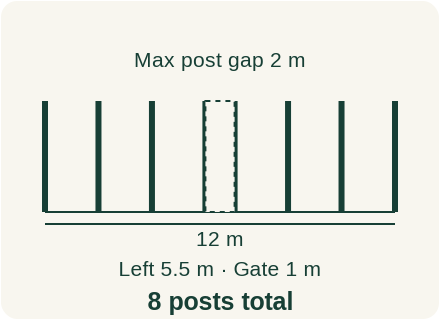
The gate is the clear opening between the two gate posts. The tool takes that opening out of the fence length. It then splits the rest into a left run (which you enter) and a right run (which it works out), so the gate doesn't have to be in the middle. Measure the left run from the left end of the fence to the edge of the gate opening.
Bays and posts
Each run is divided into bays no longer than your maximum post spacing, rounded up. Each run then gets one more post than it has bays, which covers both gate posts.
Using the defaults (a 12 m fence, a 1 m gate and a 5.5 m left run), the right run is 12 − 1 − 5.5 = 5.5 m. At 2 m spacing, each run needs ceil(5.5 ÷ 2) = 3 bays. That's 6 bays and 4 + 4 = 8 posts. With 2 rails per bay you need 12 rails. Each bay is 1.83 m, so a 2 m maximum gives you posts slightly closer together than the limit.
Palings
A run of n palings has n − 1 gaps between them. Palings per run are therefore (run + gap) ÷ (paling width + gap), rounded up. With 100 mm palings and 10 mm gaps, 5,510 ÷ 110 = 50.09, which rounds up to 51 per run. That's 102 palings in total. With a 5% allowance it's 107.1, which rounds up to 108 palings.
| Paling and gap (12 m, 1 m gate) | Per 5.5 m run | Total | With 5% |
|---|---|---|---|
| 75 mm, 10 mm gap | 65 | 130 | 137 |
| 100 mm, 0 gap (close-boarded) | 55 | 110 | 116 |
| 100 mm, 10 mm gap | 51 | 102 | 108 |
| 100 mm, 25 mm gap | 45 | 90 | 95 |
| 150 mm, 10 mm gap | 35 | 70 | 74 |
A bigger gap saves material but gives less privacy. Timber also shrinks as it dries, so a "zero gap" fence will open up over time. Pick the gap from the design you've agreed, and measure a real paling instead of trusting its label.
| Max post spacing | Bays | Posts | Rails (2 per bay) |
|---|---|---|---|
| 1.5 m | 8 | 10 | 16 |
| 1.8 m | 8 | 10 | 16 |
| 2.0 m | 6 | 8 | 12 |
| 2.4 m | 6 | 8 | 12 |
Materials and Thailand
Most Thai houses have a masonry boundary wall, so timber fences are usually internal screens, garden dividers or ระแนง panels. Fences are also made in fibre-cement planks such as Conwood, and in WPC. Outdoors in Thailand, termites and moisture are the main threats. Buy posts treated for ground contact, or use steel or concrete posts. WoodSolutions, the Australian timber body, specifies H4 treatment for posts in the ground and H3 for rails and palings. Those are Australian hazard classes, so ask your Thai supplier for the equivalent grade.
Limits
The tool doesn't design footings, post depth or wind resistance, and it doesn't count the gate leaf, hinges, latches or screws. Tall solid fences catch a lot of wind, so ask a builder about post size and footing depth for anything over about 1.8 m (general advice).
Common questions
How many posts for a 12 m fence with a 1 m gate?
At 2 m maximum spacing, 8 posts: 4 on each 5.5 m run, including both gate posts. At 1.8 m spacing you'd need 10.
How many palings for 12 m at 100 mm wide with 10 mm gaps?
You need 51 per 5.5 m run, which is 102 in total, or 108 with a 5% allowance. A close-boarded fence with no gaps needs 116.
My fence has no gate. What do I enter?
Enter 0 for the gate. The tool still splits the fence into two runs at your left-run length. Check the post count, because the point where the runs meet may be counted twice. If so, take one post off.
Does the gate have to be in the middle?
No. Enter the actual left-run length. The tool works out the right run as the total minus the gate minus the left run.
Why is the post count one more than the bays on each side?
Each run needs a post at both ends. The gate posts are the end posts of the two runs that meet at the gate.
Should I measure palings or trust the label?
Measure them. Sawn timber is often slightly narrower than its nominal size, and a few millimetres per paling adds up over a run.
Does it include concrete for the posts?
No. Count the posts here, then work out footing concrete separately with the concrete calculator.
Sources
- WoodSolutions — Fencing (treatment levels, design) ↗
- Counting method: bays = ceil(run ÷ spacing) per run, posts = bays + 1 per run, palings = ceil((run + gap) ÷ (paling + gap)), from the live tool code.
- Related:
- https://thailandinnodesign.com/en/calculators/wood-finish/ ↗
- https://thailandinnodesign.com/en/calculators/concrete/ ↗