How to calculate mulch
Back to calculator ↑Measure the area you'll cover
Measure the beds in metres. Put paths, paving, rocks and other areas you won't mulch in the excluded-area field. The exclusion has to be smaller than the total area. Calculate scattered tree beds separately and add them up. You can enter a whole plot in rai, ngan and square wah, but that only makes sense if you're mulching the whole plot.
Choose a depth
The RHS recommends organic mulch at least 5 cm deep, and ideally 7.5 cm. Thinner layers don't hold back weeds or keep moisture in well. The tool accepts depths up to 30 cm. Keep mulch away from tree trunks and woody stems, because mulch piled against bark keeps it damp and encourages rot. That's general advice from RHS guidance.
Worked example
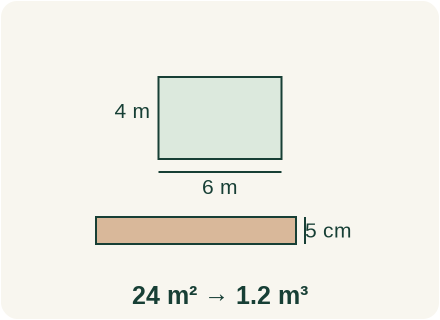
With the defaults, 6 × 4 m = 24 m². At 5 cm deep that's 1.2 m³. With 10% allowance it's 1.32 m³, which is 1,320 L, or 33 bags of 40 L. If a 2 m² path crosses the bed, the area becomes 22 m², so 1.1 m³, then 1.21 m³ with allowance, which is 31 bags.
| Depth over 24 m² | Volume | With 10% | 40 L bags |
|---|---|---|---|
| 3 cm | 0.72 m³ | 0.792 m³ | 20 |
| 5 cm | 1.2 m³ | 1.32 m³ | 33 |
| 7.5 cm | 1.8 m³ | 1.98 m³ | 50 |
| 10 cm | 2.4 m³ | 2.64 m³ | 66 |
Bag size changes the count, but not the cost per litre. At 5 cm, the same 1,320 L is 53 bags of 25 L or 27 bags of 50 L. Compare litres per baht, not the shelf price per bag.
Thai mulch materials
Common Thai options include coconut coir (ขุยมะพร้าว), chopped coconut husk (กาบมะพร้าว), shredded bark (เปลือกไม้สับ), rice straw (ฟางข้าว) and dried leaves. Decorative stone is also used. These are general notes. Straw and leaves break down within months in Thai heat and rain, so expect to top them up more often than bark. Coir holds a lot of water, which helps in the dry season but can stay soggy in the rains. For stone, use the aggregates calculator. It works out the same volume, and stone is often sold by the คิว (m³).
Limits
Loose mulch settles, and a bulk delivery quoted in m³ may be measured loose rather than spread. Ask the seller which. The tool works out volume only. It doesn't choose the material or account for the mulch breaking down.
Common questions
How many 40 L bags of mulch for 24 m² at 5 cm?
You need 1.2 m³, or 1.32 m³ with 10% allowance. That's 1,320 L, or 33 bags of 40 L.
How deep should mulch be?
The RHS suggests at least 5 cm, and ideally 7.5 cm, for organic mulch. Going much deeper over tree roots isn't usually needed, and mulch should never touch the trunks.
How many litres in one m³?
1,000 L. One คิว (1 m³) of mulch is 25 bags of 40 L. Bulk is often cheaper above about 1 m³.
Should I subtract stepping stones and paths?
Yes. Put them in the excluded area so the allowance only covers mulch you'll spread.
Why add 10%?
It covers uneven ground, settling and spillage. Raise it for very loose materials such as straw, which squash down a lot.
Can I lay mulch on dry soil?
It's better to water dry soil first, then mulch. Mulch on dry soil can keep light rain from soaking in. This is general advice.
Can I use this for decorative stone?
The volume works the same. Stone is usually sold by weight or by the คิว, though, so the aggregates calculator with a 30–50 mm depth may suit it better.