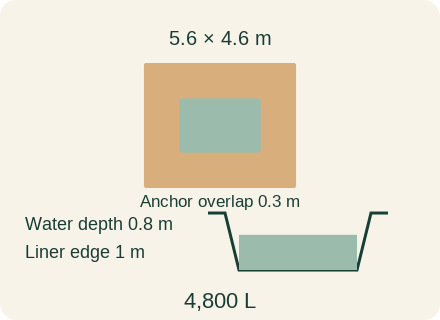
Estimate pond water and liner
Back to calculator ↑Water volume
Volume = inside length × inside width × water depth, in metres, giving cubic metres. Multiply by 1,000 for litres. Use the depth the water actually reaches, usually set by the overflow or the edge stones, not the depth you dug. If the pond has a shallow planting shelf and a deeper section, work them out separately and add them.
Liner size
The liner has to cover the floor, run up both side walls and extend past each edge so it can be anchored under stones or soil. For each direction:
Liner length = pond length + 2 × depth + 2 × anchor allowance Liner width = pond width + 2 × depth + 2 × anchor allowance
The calculator uses 0.3 m per edge as the anchor allowance by default. Measure your actual edging, because a wide stone border needs more.
Worked default example
A pond 3 × 2 m with 0.8 m of water holds 4.8 m³, or 4,800 L. The liner needs to be 3 + 1.6 + 0.6 = 5.2 m long and 2 + 1.6 + 0.6 = 4.2 m wide, which is 21.84 m². Increasing the anchor allowance to 0.5 m per edge makes the sheet 5.6 × 4.6 m (25.76 m²).
| Pond (L × W × depth) | Water | Liner sheet | Liner area |
|---|---|---|---|
| 2 × 1.5 × 0.6 m | 1,800 L | 3.8 × 3.3 m | 12.54 m² |
| 2 × 2 × 0.5 m | 2,000 L | 3.6 × 3.6 m | 12.96 m² |
| 3 × 2 × 0.8 m | 4,800 L | 5.2 × 4.2 m | 21.84 m² |
| 4 × 3 × 1.0 m | 12,000 L | 6.6 × 5.6 m | 36.96 m² |
| 5 × 3 × 1.2 m | 18,000 L | 8.0 × 6.0 m | 48.00 m² |
Check the roll width, not just the area
Liners are sold by roll width and length, whether PVC, EPDM or the HDPE sheet often used for farm ponds in Thailand (ผ้ายางปูบ่อ). The narrower liner dimension must fit within one roll's width. A 4.2 m sheet won't come out of a 4 m roll, even if the roll's total area is far more than 21.84 m². If no single width fits, ask the supplier about a factory-welded seam. Don't improvise one with tape.
Thai conditions
Evaporation is high in the hot season. As an example, a drop of 5 mm a day across a 3 × 2 m surface is 30 L a day to top up. Still water breeds mosquitoes, including the species that carry dengue, so plan for fish, a pump or a fountain to keep the water moving. Tropical sun degrades cheap liners. Keep the exposed edges covered with stones, soil or edging.
Limits
The formula assumes straight, vertical walls. Sloped sides, curves and planting shelves change both volume and liner size. Measure them as separate sections, or lay a rope along the dug shape and measure the rope. Corner folds can use extra material. The litres figure is geometry only. It doesn't tell you how many fish the pond can hold or what pump and filter to buy.
Common questions
What size liner do I need for a 3 × 2 m pond?
At 0.8 m deep with 0.3 m anchoring each side, you need a 5.2 × 4.2 m sheet (21.84 m²). Deeper ponds need more: each extra 10 cm of depth adds 20 cm to both dimensions.
How many litres are in my pond?
Length × width × depth × 1,000. A 3 × 2 m pond at 0.8 m deep holds 4,800 L, and each 10 cm of depth adds 600 L.
How much anchor allowance should I leave?
At least 0.3 m per edge for soil or light stones. Allow 0.5 m or more under a wide stone or paved border. Measure the planned edging first.
Can I use this for a pond with sloped sides?
Only roughly. Sloped walls are longer than the depth, so measure each slope and use it in place of depth for the liner. Treat the volume as an upper estimate.
Why can't I just buy enough total area?
The liner must be one piece large enough in both directions. A narrow roll can't be cut into a wider sheet without a proper seam.
Does the volume tell me how many fish I can keep?
No. Fish numbers depend on filtration, oxygen, species and feeding. Use the volume to talk to an aquarium or pond supplier.
How do I stop mosquitoes breeding?
Keep the water moving with a pump or fountain, or keep fish that eat larvae. Clear leaves that create still, sheltered corners.