Roller blind measurement guide
Back to calculator ↑Measure the opening properly
Use a steel tape and work in millimetres. Measure the width at the top, middle and bottom, and the height at the left, centre and right. Blinds.com advises measuring every window individually, even ones that look identical, and always recording sizes as width × height so the two never get swapped. Before you settle on a position, note handles, aircon pipes, curtain tracks and how much flat wall there is above and beside the window.
Outside or inside mount?
This calculator is for outside mounts, where the blind sits on the wall or frame and overlaps the opening. That suits most Thai condo windows, which are often shallow aluminium frames with no room for a blind inside. An inside mount sits within the recess and follows different rules. Blinds.com's inside-mount method is to check the recess depth against the product's minimum, measure the width at the top only, take the tallest of three heights, and order the exact opening size. The factory then makes the deductions. Don't use this tool's overlaps for an inside mount.
How the order size is built
Order width is the opening width plus both side allowances. Order drop is the opening height plus the combined top and bottom allowance. Each opening gets one blind.
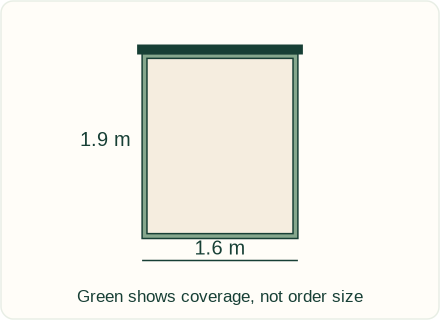
Worked example (tool defaults): a 1.5 m opening plus 0.05 m each side gives a 1.60 m order width. A 1.8 m height plus a 0.1 m combined allowance gives a 1.90 m drop. Three equal windows need three blinds, each 1.60 × 1.90 m.
Blinds.com suggests 2–3 inches (about 5–7.5 cm) per side on windows without trim. Above the opening it suggests about 3 inches (about 7.5 cm) for the brackets. Where there's no protruding sill, it suggests extending about 2 inches (about 5 cm) below the sill.
| Setup | Side allowance (each) | Top + bottom allowance | Order width | Order drop |
|---|---|---|---|---|
| Tool default | 0.05 m | 0.10 m | 1.60 m | 1.90 m |
| Blinds.com, no sill (≈7.5 cm above + 5 cm below) | 0.075 m | 0.13 m | 1.65 m | 1.93 m |
| Bedroom, extra light control | 0.10 m | 0.20 m | 1.70 m | 2.00 m |
Fabric width is not order width
With most roller blinds, the width you order is measured bracket to bracket, and the fabric itself is narrower. Blinds.com says to decide the fabric width you want and add about 3 inches (7.5 cm) to get the bracket-to-bracket width. If you need 1.60 m of actual fabric, that means ordering about 1.68 m. Ask each seller which width their size refers to, because shops differ. This is the most common reason a new blind leaves light gaps down the sides.
Wide windows and maximum widths
Condo balcony doors are often 2.0–2.4 m wide. A 2.4 m opening with 0.05 m per side needs a 2.50 m order width, which is more than many roller systems can make. Enter the model's maximum width under "More settings" and the result will show whether your size fits. If it doesn't, choose a model with a wider limit or split the opening into two blinds of about 1.25 m each. Two blinds leave a narrow light gap where they meet, so plan the join at a mullion if there is one. Two blinds are also easier to use on a door you walk through.
Fixing and safety
Concrete walls need suitable plugs. In a gypsum ceiling, fix into the metal frame or use fixings rated for board, never bare gypsum alone. Check that the roller and brackets clear the handle when the window opens. Confirm which side the chain or motor goes on before ordering. Where children live or visit, keep cords and chains tensioned to the wall or out of reach and follow the product's cord-safety instructions.
Limits of this estimate
The default overlaps are starting points, not guarantees of blackout or bracket clearance. The tool repeats one size for every opening, so calculate windows of different sizes separately. It doesn't price fabric, motors or installation.
Common questions
How much bigger than the window should an outside-mount blind be?
Blinds.com suggests about 5–7.5 cm on each side and about 7.5 cm above the opening for the brackets. The tool's 5 cm per side and 10 cm vertical is a moderate start. For bedrooms, 10 cm per side cuts light leaks noticeably if the wall allows.
Is the width I order the fabric width?
Usually not. Most sellers measure the order width bracket to bracket, and the fabric is a few centimetres narrower. Ask the seller, and if their size is bracket to bracket, add about 7.5 cm to the fabric width you need.
Can I use this calculator for an inside mount?
Not directly. Inside mounts are usually ordered at the exact opening size, with the factory making the deductions. Follow the chosen seller's inside-mount instructions and check the minimum recess depth first.
My windows look the same. Can I enter them as one size?
Only after measuring each one. Windows in the same building can differ by several millimetres, which matters for blinds. If any window differs, run it separately.
What if my order width exceeds the model's maximum?
Choose a different system with a wider limit, or divide the opening into two or more blinds. With a 2.50 m order and a 2.0 m limit, two blinds of about 1.25 m work, with a small gap where they meet.
Will a roller blind block all light?
A blackout fabric stops light through the fabric, but light still passes round the edges of an outside mount. Wider overlaps help, and a blind combined with curtains gives the darkest room. For full darkness, ask about side channels or cassette systems.
Can I install a blind on a gypsum ceiling?
Yes, but fix into the ceiling frame or use fixings rated for board. A blind's weight and the pull on it in daily use can tear screws out of bare gypsum. If you can't find the frame, mount on the wall above the window instead.